
Friday After Ash Wednesday
After the Rain: Preparation for the Light
Yesterday the rain came down steady and sure, drumming against the windows, soaking the ground, washing the dust and pollution from the air. This morning the sun broke through like a quiet promise. The air feels lighter. The sky seems wider. Even the river looks different when the light hits it after a storm.
That is how Lent feels to me today.
Not gray despair.
Not spiritual gloom.
But preparation for the light.
The Collect
Support us, O Lord, with your gracious favor through the fast we have begun; that as we observe it by bodily self-denial, so we may fulfill it with inner sincerity of heart; through Jesus Christ our Lord, who lives and reigns with you and the Holy Spirit, one God, for ever and ever. Amen.
Scripture Appointed for Today
Isaiah 58:1–9a
“Is not this the fast that I choose: to loose the bonds of injustice… to share your bread with the hungry… Then your light shall break forth like the dawn.”
Psalm 51:1–10
“Wash me, and I shall be clean indeed… Create in me a clean heart, O God.”
Matthew 9:10–17
“I desire mercy, not sacrifice… New wine is put into fresh wineskins.”
Devotional Reflection
The prophet Isaiah thunders like yesterday’s storm:
“Shout out, do not hold back!”
He warns against a hollow fast — the kind that bows the head but keeps the heart clenched. A fast that gives up bread but not pride. A fast that looks holy but remains unmerciful.
I have known that kind of fasting.
There were seasons in my life when I fasted to prove something — to myself, perhaps even to God. I could skip meals. I could endure the discipline. But endurance alone did not soften me. Hunger alone did not transform me.
What changed was not the absence of food — it was the presence of honesty.
Psalm 51 has become my companion in these days:
“Wash me through and through… create in me a clean heart.”
Yesterday’s rain washed the pollen and dust from everything it touched. Today, the sunlight reveals what has been cleansed. Lent works the same way. Repentance is the rain. Mercy is the sunrise.
Fasting, when it is sincere, clears space inside me. It quiets the noise. It loosens my grip on small comforts. It exposes how quickly I reach for distraction instead of prayer. And in that clearing, I begin to notice something deeper — not just my hunger, but the hunger of others.
Isaiah says the fast God chooses loosens bonds, feeds the hungry, shelters the poor. True fasting stretches outward.
And then there is Jesus.
While others questioned why His disciples did not fast as expected, He sat at the table with tax collectors and sinners. He said, “I desire mercy, not sacrifice.”
Lent is not about impressing heaven.
It is about making room for mercy.
When Jesus speaks of new wine and fresh wineskins, I hear Him saying: You cannot pour resurrection life into a rigid heart. Something must soften. Something must stretch. Something must be made new.
Fasting, for me, is the stretching.
The rain yesterday softened the earth. The sun today warms it. Soon, what has been planted will rise. That is not despair — that is preparation.
And perhaps that is what this Friday after Ash Wednesday is teaching me:
The fast is not an end.
The ashes are not the conclusion.
The rain is not the whole story.
Light is coming.
A Personal Story
There is a story often told of John Wesley, who once said of fasting, “First let him be taught to deny himself.” Wesley practiced regular fasting, not as punishment, but as preparation — preparation for prayer, clarity, and compassion. He believed fasting sharpened the soul’s awareness of God and neighbor.¹
I have found that to be true. When I fast rightly — not to perform, but to open — my prayers deepen. My patience lengthens. My awareness of others increases.
The hunger in my body becomes a quiet tutor, reminding me: You are not self-sustaining. You are sustained.
My Testimony of Fasting
In my own journey, fasting has been less about willpower and more about surrender. There were times when my life felt cluttered — full of noise, ambition, distraction. Fasting cleared a path. It revealed attachments I did not know I had. It showed me how often I fill emptiness with anything but God.
But when I stayed with the discipline — when I allowed Psalm 51 to become my prayer — I found something unexpected:
Joy.
Not the loud joy of celebration.
But the quiet joy of alignment.
The quiet joy of sunlight after rain.
Charge
Beloved, do not let Lent become gray resignation.
Let it be rain that softens you.
Let it be honesty that cleanses you.
Let it be hunger that awakens mercy in you.
Fast in such a way that light breaks forth.
Fast in such a way that others are fed.
Fast in such a way that your heart becomes a fresh wineskin for the new wine of Christ.
And when you cry out, listen — for the Lord says, “Here I am.”
Closing Prayer
Lord of mercy and morning light,
Wash us as the rain washes the earth.
Soften what has hardened in us.
Stretch what has grown rigid.
Create in us clean hearts, O God.
May our fasting make room for compassion.
May our repentance prepare us for resurrection.
And may Your light break forth in us like the dawn.
Through Jesus Christ our Lord.
Amen.
Footnotes
John Wesley, Sermon 27: Upon Our Lord’s Sermon on the Mount, Discourse VII, in which he emphasizes the spiritual discipline of fasting as preparation for inward holiness.

Lent 2026: Listening for God's Voice
Welcome to a season of profound listening. As Ash Wednesday ushers in Lent 2026, we invite you to quiet your heart and tune into the divine whisper. This journey isn't about grand gestures, but a gentle turning back to the One who calls you home. Explore reflections, scripture, and prayers designed to guide you toward hearing God's voice for your life this year.
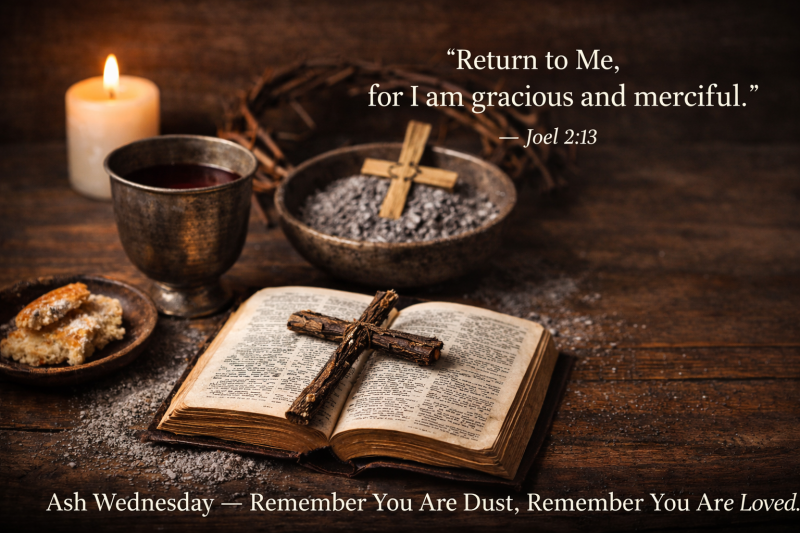
Ash Wednesday — A Call to Come Home
The Collect
Almighty and everlasting God,
You hate nothing You have made and forgive the sins of all who are penitent:
Create and make in us new and contrite hearts,
that we, worthily lamenting our sins and acknowledging our frailty,
may obtain from You, the God of all mercy,
perfect remission and forgiveness;
through Jesus Christ our Lord,
who lives and reigns with You and the Holy Spirit,
one God, for ever and ever. Amen.
The Lessons Appointed for Ash Wednesday
Old Testament: Joel 2:1–2, 12–17 or Isaiah 58:1–12
Psalm: Psalm 103:8–14
Epistle: 2 Corinthians 5:20b–6:10
Gospel: Matthew 6:1–6, 16–21
Reflection
Ash Wednesday never arrives loudly.
There are no trumpets of celebration. No lilies dressed in white. Just ashes — soft, gray, humbling — pressed gently upon the forehead with the words:
“Remember that you are dust, and to dust you shall return.”
And somehow, in that sentence, there is both sobriety and mercy.
The prophet Joel sounds an alarm — “Blow the trumpet in Zion!” He speaks of darkness and trembling, of a day of reckoning. But then the tone shifts, and you can almost hear the tenderness in God’s voice:
“Return to Me with all your heart…
Rend your hearts and not your garments.”
Not outward drama.
Not religious performance.
Your heart.
Isaiah sharpens it even more. The fast God chooses is not theatrical sorrow. It is breaking chains. Feeding the hungry. Opening your home. Repairing what has been broken. True repentance always turns outward in love.
Then Jesus brings it home in Matthew’s Gospel.
When you give, do it quietly.
When you pray, shut the door.
When you fast, wash your face.
In other words — this is not about being seen.
Ash Wednesday strips us of the need to impress God.
Paul pleads in Corinthians, “Be reconciled to God… Now is the day of salvation.” Not when you have it all together. Not when you feel strong. Now.
And Psalm 103 steadies the whole thing like a father placing a hand on your shoulder:
“The Lord is full of compassion and mercy…
He has not dealt with us according to our sins…
He remembers that we are but dust.”
Dust, yes.
But dust remembered.
Dust loved.
Dust forgiven.
A Story of Ashes and Mercy
There is a story told by the late evangelist Billy Graham, who once said that early in his ministry he struggled deeply with discouragement. He felt inadequate, painfully aware of his flaws, convinced at times that God could use someone far better. In one season of doubt, he wrote in his Bible that he was surrendering his pride, his ambition, and even his fear — placing it all before the Lord.¹
What strikes me about that moment is not the public crusades or the crowds that would come later. It’s the quiet surrender. The private repentance. The honest confession of weakness.
That is Ash Wednesday.
Not the spotlight — the surrender.
Not the applause — the altar.
Years ago, I remember standing in a small country church on Ash Wednesday feeling much the same way — tired, worn thin, unsure what I had left to give. When the ashes were pressed on my forehead, I expected shame. Instead, I felt relief.
Dust doesn’t have to perform.
Dust doesn’t have to pretend to be marble.
Dust simply returns to the hands that formed it.
A Word from Holly
My friend and Christian author, Holly Martin wrote this today, and it fits Ash Wednesday like a key in a well-worn lock:
“Being part of Jesus’ family means you don’t perform for a seat at the table, and that’s because you’re already seated.
It means your last name is no longer ‘forgotten,’ but ‘chosen.’
Being in Jesus’ family means you have access to Him even on your worst day. Especially on your worst day!
Being a part of His family means the King of Heaven calls you his own.”
~ Holly Martin
That’s the heart of Lent.
You are not fasting to earn a seat.
You are not praying to secure your inheritance.
You are not giving to impress heaven.
You are already seated.
Ash Wednesday begins not with rejection — but with belonging.
What Lent Is For
Lent reorders our loves.
Jesus says, “Where your treasure is, there your heart will be also.”
So we fast to remember what truly feeds us.
We pray to remember who truly sees us.
We give to remember what truly lasts.
Isaiah says the fast God chooses breaks chains.
Joel says return with your whole heart.
Paul says now is the day.
The Psalm says He remembers you are dust.
Jesus says your Father sees in secret.
All of it whispers the same invitation:
Come home.
The Charge
Beloved, as you enter this holy season:
Return to the Lord with your whole heart.
Rend your heart and not your garments.
Fast in a way that frees someone.
Pray in a way that deepens love.
Give in a way that no one sees but your Father.
Remember you are dust — and deeply loved.
Remember you are frail — and fiercely held.
Remember you belong.
Walk these forty days not as performers, but as children coming home.
Closing Prayer
Merciful Father,
You remember that we are dust.
You know our weakness and You do not turn away.
Create in us clean hearts, O God.
Loosen what binds us.
Soften what has grown hard.
Humble what has grown proud.
Teach us the fast that frees,
the prayer that listens,
the giving that loves quietly.
And as we walk toward the cross,
hold us in the assurance
that we are already seated at Your table,
already called Your own,
already covered in mercy.
Through Jesus Christ our Lord. Amen.
¹ Adapted from accounts of Billy Graham’s early ministry struggles and personal surrender, reflected in his autobiographical writings such as Just As I Am (1997).
Create Your Own Website With Webador